On October 8, Orkut founder Orkut Buyukkokten relaunched orkut.com not as a working social network, but as a global sign-up campaign—a petition-style page asking users to express support for a "more human" social platform built around connection rather than algorithmic engagement. The move resurrects a brand that Google shut down in 2014, and it's already crossed 375,000 signatures in its first 48 hours. The Orkut founder relaunches social network campaign arrives at a moment when trust in mainstream platforms is fracturing, making the nostalgia play unexpectedly resonant—particularly in Brazil and India, where the original Orkut once dominated the social landscape before Facebook's rise. What makes this different from a simple rebranding exercise is the founder's explicit framing of the problem: two decades of feeds "built around engagement, not connection" have produced a generation of lonely, anxious users. Whether this campaign becomes a real product or repeats the pattern of previous failed relaunches remains an open question.
Happenings
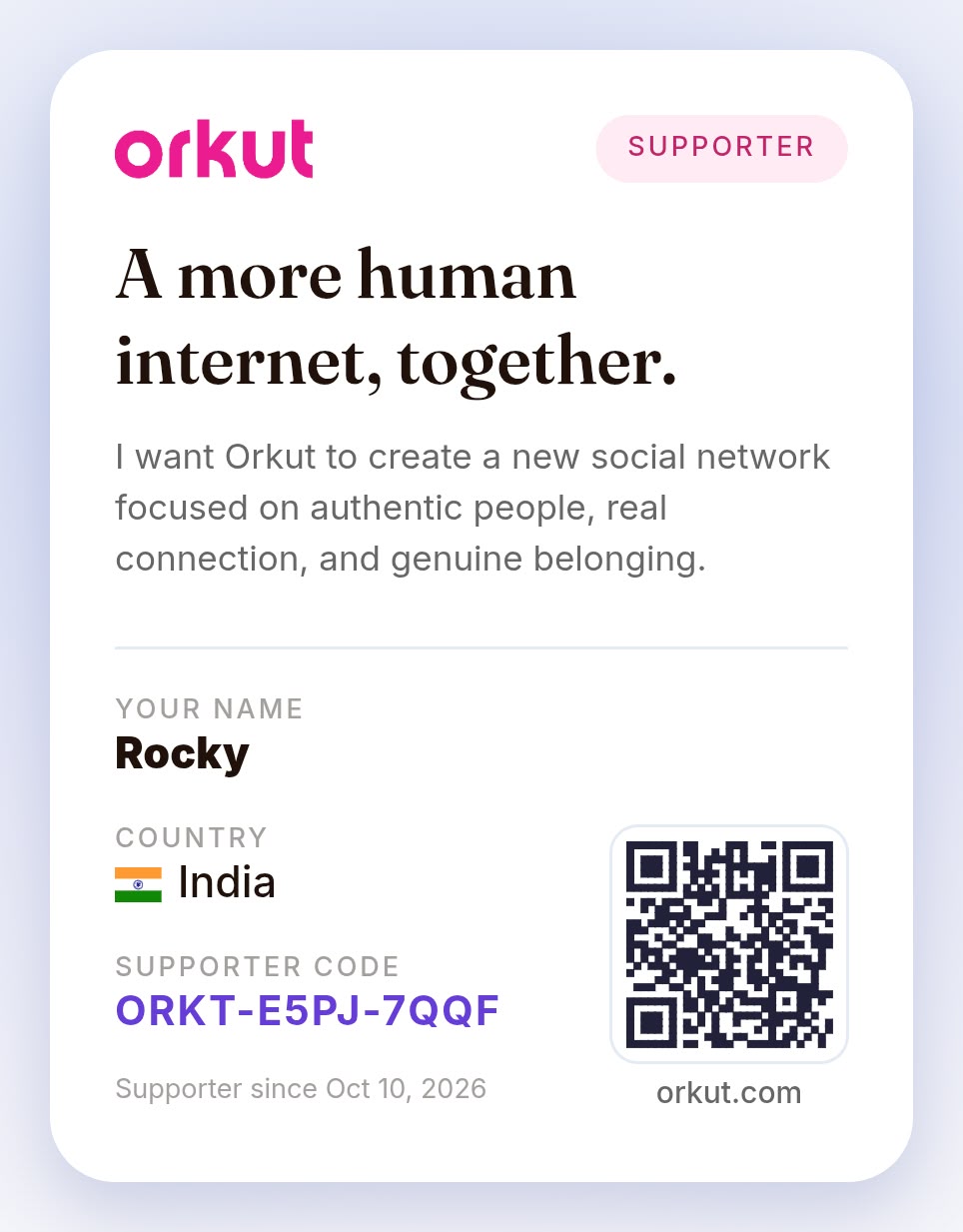
On October 8, 2026, orkut.com went live with a single, carefully designed page: a "Sign the petition" card paired with a live signature counter, real-time stat tiles, and a rotating feed of named signers by country. Within 24 hours, the page had accumulated 54,443 signatures. By October 10, the counter had climbed past 375,000, with new signatures arriving at a rate of roughly 2,000 per hour at peak moments. The page's form is deliberately gated—visitors must select their age first before any other field (name, country, email, phone) unlocks. Once completed, signers receive a unique code and a shareable "supporter card" badge displaying their name, country flag, join date, and a QR code linking back to orkut.com. The page's own fine print explicitly states this is "not a petition to any government, agency or company" and reserves "no username, an account, or a place in line"—a legal disclaimer that sits in direct tension with the petition-style presentation.
The geographic distribution tells a story. Brazil accounts for 67.4% of all signatures, followed by Portugal (10.6%), Ireland (2.5%), Paraguay (2.1%), and Belize (1.7%). India appears in the top ten at 0.8%. This pattern mirrors the original Orkut's user base exactly: Brazil and India were the platform's dominant markets in the mid-2000s through early 2010s, long before Facebook overtook it. The campaign has reached 144 countries. Buyukkokten, a Turkish-American former Google engineer who created Orkut as a side project in January 2004, frames this not as a resurrection but as a corrective—one that explicitly addresses AI's role in eroding trust online.
Effects
The immediate effect is visibility. A dormant brand name has re-entered the conversation in tech and culture media, with Brazilian outlets (Canaltech, Meio & Mensagem, Diario de Pernambuco) leading coverage. For users in their late twenties and thirties who spent formative years on the original Orkut, the relaunch triggers genuine nostalgia—and the sign-up mechanics are designed to amplify that. The shareable supporter card and the explicit ask to "tell everyone else" turn each signup into a recruitment moment, a social proof loop that accelerates word-of-mouth.
But the effects are also speculative. We are seeing a campaign, not a product. No launch date exists. No feature roadmap has been announced. No guarantee that a real platform will ship. For people signing up expecting a return of old Orkut data—photos, scrapbooks, communities—there's nothing promised. The page makes no commitment to recover that lost content. What does exist is a statement of intent: a founder arguing that social media should help people find genuine belonging, not maximize engagement metrics. Whether that philosophical position translates into a viable alternative to Meta, TikTok, or Discord remains entirely unclear.
Likely Viewpoints
The positions below are Trynews's AI-synthesized analysis of the likely sides of this debate — not quotes from named sources.
Supporters of the Orkut founder relaunches social network campaign see genuine merit in the critique. They argue that twenty years of engagement-maximizing algorithms have demonstrably harmed mental health, particularly among younger users—a claim backed by internal Meta documents, academic research, and testimony from former platform executives. From this angle, Buyukkokten's framing resonates: a platform explicitly designed around "authentic people, real connection, and genuine belonging" rather than time-on-site metrics represents a meaningful alternative to the current landscape. The fact that 375,000+ people signed within 48 hours, with particularly strong response in Brazil and India (Orkut's historical strongholds), suggests real appetite for something different. His engagement with AI—positioning it as a trust-verification tool rather than a replacement for human connection—also addresses a genuine emerging anxiety about deepfakes and synthetic media eroding confidence in what's real online. To this camp, the campaign itself, even if it never ships, serves a valuable function: it names the problem and signals that alternatives are thinkable.
Critics and skeptics counter that Buyukkokten's track record undermines the promise. The original Orkut lost to Facebook not because of philosophical differences but because Facebook was better-engineered and more useful. His subsequent ventures—the "Hello" app and the 2022 teaser—generated similar buzz and yielded nothing. A sign-up page that explicitly disclaims being a petition, reserves no username or account, and promises no timeline is, by design, risk-free for the founder but requires nothing of him. The Brazilian media outlets covering this week's launch noted that Orkut Inc. declined to answer basic questions about features, launch dates, or data recovery. Without specifics, the campaign reads less as a credible product roadmap and more as a brand-rehabilitation exercise or a test of nostalgic sentiment. The question isn't whether the current internet is broken—it plainly is—but whether a founder who's failed to ship a social platform in over a decade can actually build one now, particularly one that solves the coordination problem of attracting billions of users away from entrenched networks.
After Effects
The next 60 days will likely determine whether this gains momentum or follows the 2022 pattern into silence. Watch for three concrete signals: a public statement from Orkut Inc. addressing timeline and feature specifics; the rate at which signature growth accelerates or plateaus (the current pace of 54,000 daily signups is significant but may reflect initial nostalgia spike rather than sustained interest); and any announcement of seed funding or technical hires that would suggest serious development infrastructure.
By late December 2026, if nothing more substantive emerges, the campaign will have entered the familiar holding pattern. Brazilian and Portuguese-language tech media will likely continue coverage given the geographic concentration of signers, but English-language tech press attention will fade unless there's a concrete deliverable.
The real milestone to watch is whether a working beta—even a limited, closed-alpha version—launches within the next 12-18 months. That would break the cycle. Without it, the 375,000+ signatures become a historical curiosity: proof that people want alternatives to algorithmic feeds, but no proof that Buyukkokten can build one. The absence of a promised feature list, launch window, or data-recovery plan for old Orkut content suggests the founder may be testing market sentiment before committing resources, which is strategically sound but leaves supporters without a concrete commitment to hold him to.
The Whole Picture
Orkut founder relaunches social network campaign reflects a genuine cultural moment: widespread exhaustion with engagement-driven platforms has created real appetite for alternatives, and nostalgia for early social networks—when connection felt less mediated and more intimate—carries real emotional weight, especially in Brazil and India where Orkut was formative.
But the campaign's actual substance remains deliberately vague. It's a petition that isn't a petition, a product announcement that announces nothing, and a founder's third attempt to resurrect a network he lost to Facebook over a decade ago. The fact that 375,000 people signed in two days is real; the fact that signing reserves nothing is equally real. The critique of algorithmic feeds is sound; the proof that Buyukkokten can build something better remains absent.
This isn't a scam—the page is transparent about what it is and isn't. But it's also not yet a product, a timeline, or a commitment. It's a test: does nostalgia plus frustration equal an audience? The answer, for now, appears to be yes. Whether that audience becomes a platform is an entirely different question.